
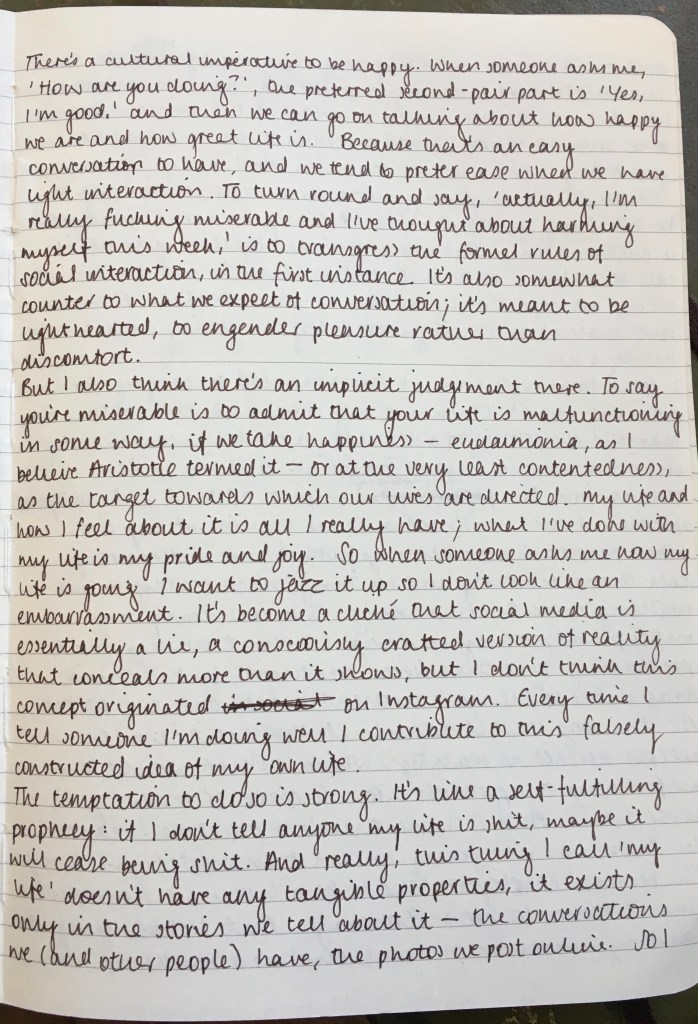
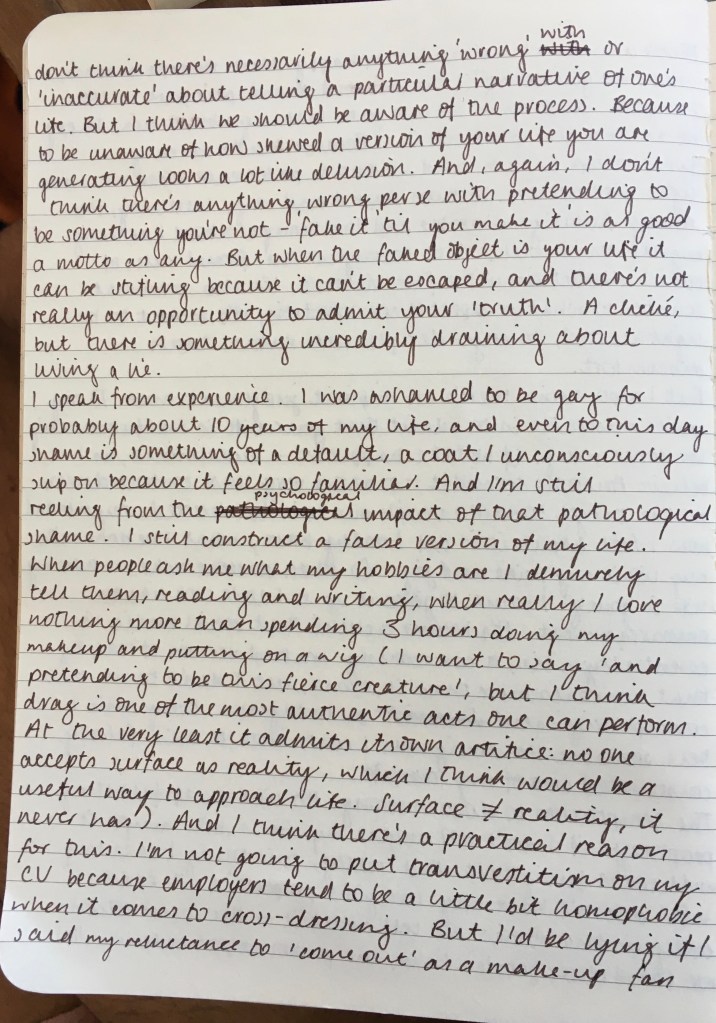
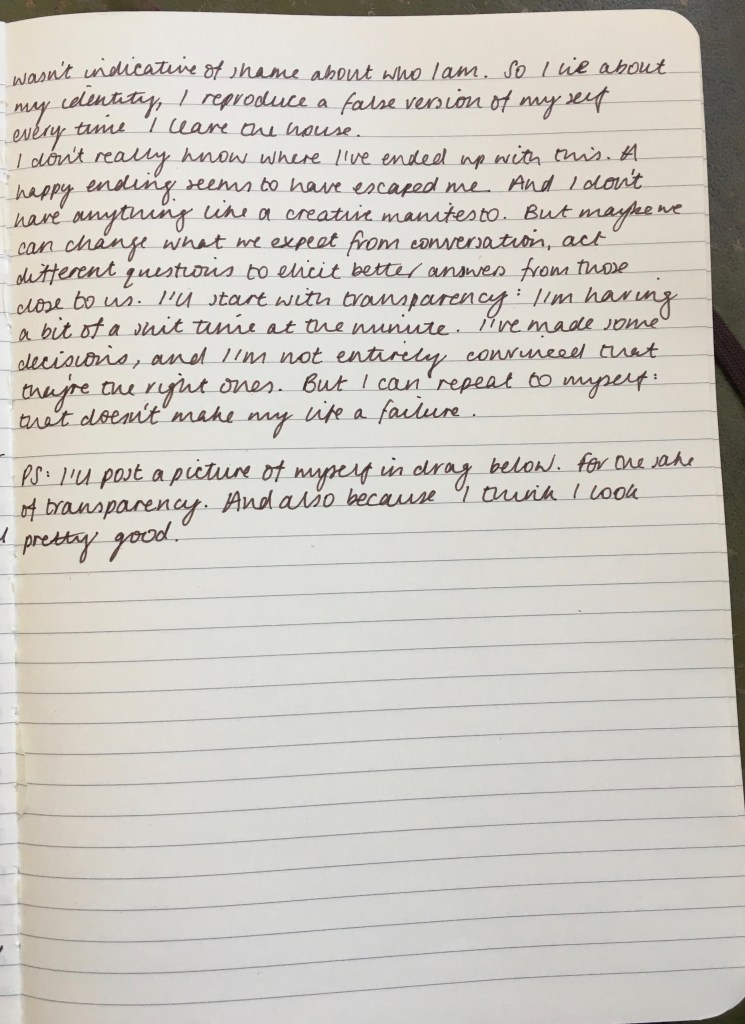
I’m trying something a bit new here. If I’m honest, I don’t really like writing things straight onto the computer; something about the computer keys don’t feel authentic. (Ironic that I’m writing these words straight onto the keyboard.) Might be a weird thing to say, but I’ve always felt much more at home with the pen in hand when it comes to writing, and I think my writing is a lot better. Using the pen feels like a better expression of myself because that’s the medium I’ve become accustomed to. But I also don’t want to edit what I hand-write in uploading it here, because the whole point of this is that I want it to be less thought-out. So I’m going to try something out. Below I’ve written something similar to what I’ve written before, but I’ve uploaded it as an image of the pages of my journal. I find it a bit more satisfying to write on paper and it’s also a slower process, which means I’m a bit more to the point I think.
Below I’ve also included a transcribed version, in case you can’t read my writing and to make it more accessible. I’ve also corrected any glaring mistakes (such as using the wrong word) which can happen when I hand-write things without checking, but I’ll keep that to a minimum because it feels a bit counterintuitive to what I’m doing.
Anyway, I hope this new format works. I’ll probably find it easier to keep on top of as well since I prefer hand-writing things.
[Transcribed:
There’s a cultural imperative to be happy. When someone asks me, ‘How are you doing?’ the preferred second-pair part is ‘Yes, I’m good,’ and then we can go on talking about how happy we are and how great life is. Because that’s an easy conversation to have, and we tend to prefer ease when we have light interaction. To turn round and say, ‘actually, I’m really fucking miserable and I’ve thought about harming myself this week,’ is to transgress the formal rules of social interaction, in the first instance. It’s also somewhat counter to what we expect of conversation; it’s meant to be lighthearted, to engender pleasure rather than discomfort.
But I also think there’s an implicit judgement there. To say you’re miserable is to admit that your life is malfunctioning in some way, if we take happiness – eudaimonia, as I believe Aristotle termed it – or at the very least contentedness, as the target towards which our lives are directed. My life and how I feel about it is all I rally have; what I’ve done with my life is my pride and joy. So when someone asks me how my life is going I want to jazz it up so I don’t look like an embarrassment. It’s become a cliché that social media is essentially a lie, a consciously crafted version of reality that conceals more than it shows, but I don’t think this concept originated on Instagram. Every time I tell someone I’m doing well I contribute to this falsely constructed idea of my own life.
The temptation to do so is strong. It’s like a self-fulfilling prophecy: if I don’t tell anyone my life is shit, maybe it will cease being shit. And really, this thing I call ‘my life’ doesn’t have any tangible properties, it exists only in the stories we tell about it – the conversations we (and other people) have, the photos we post online. So I don’t think there’s necessarily anything ‘wrong’ with or ‘inaccurate’ about telling a particular narrative of one’s life. But I think we should be aware of the process. Because to be unaware of how skewed a version of your life you are generating looks a lot like delusion. And, again, I don’t think there’s anything wrong per se with pretending to be something you’re not – ‘fake it ’til you make it’ is as good a motto as any. But when the faked object is your life it can be stifling because it can’t be escaped, and there’s not really an opportunity to admit your ‘truth’. A cliché, but there is something incredibly draining about living a lie.
I speak from experience. I was ashamed to be gay for probably about 10 years of my life, and even to this day shame is something of a default, a coat I unconsciously slip on because it feels so familiar. And I’m still reeling from the psychological impact of that pathological shame. I still construct a false version of my life. When people ask me what my hobbies are I demurely tell them, reading and writing, when really I love nothing more than spending 3 hours doing my makeup and putting on a wig (I want to say ‘and pretending to be this fierce creature’, but I think drag is one of the most authentic acts one can perform. At the very least it admits its own artifice: no one accepts surface as reality, which I think would be a useful way to approach life. Surface ≠ reality, it never has). And I think there’s a practical reason for this. I’m not going to put transvestitism on my CV because employers tend to be a little homophobic when it comes to cross-dressing. But I’d be lying if I said my reluctance to ‘come out’ as a make-up fan wasn’t indicative of shame about who I am. So I lie about my identity, I reproduce a false version of myself every time I leave the house.
I don’t really know where I’ve ended up with this. A happy ending seems to have escaped me. And I don’t have anything like a creative manifesto. But maybe we can change wha we expect from conversation, act [ask] different questions to elicit better answers from those close to us. I’ll start with transparency: I’m having a bit of a shit time at the minute. I’ve made some decisions, and I’m not entirely convinced that they’re the rights ones. But I can repeat to myself: that doesn’t make my life a failure.
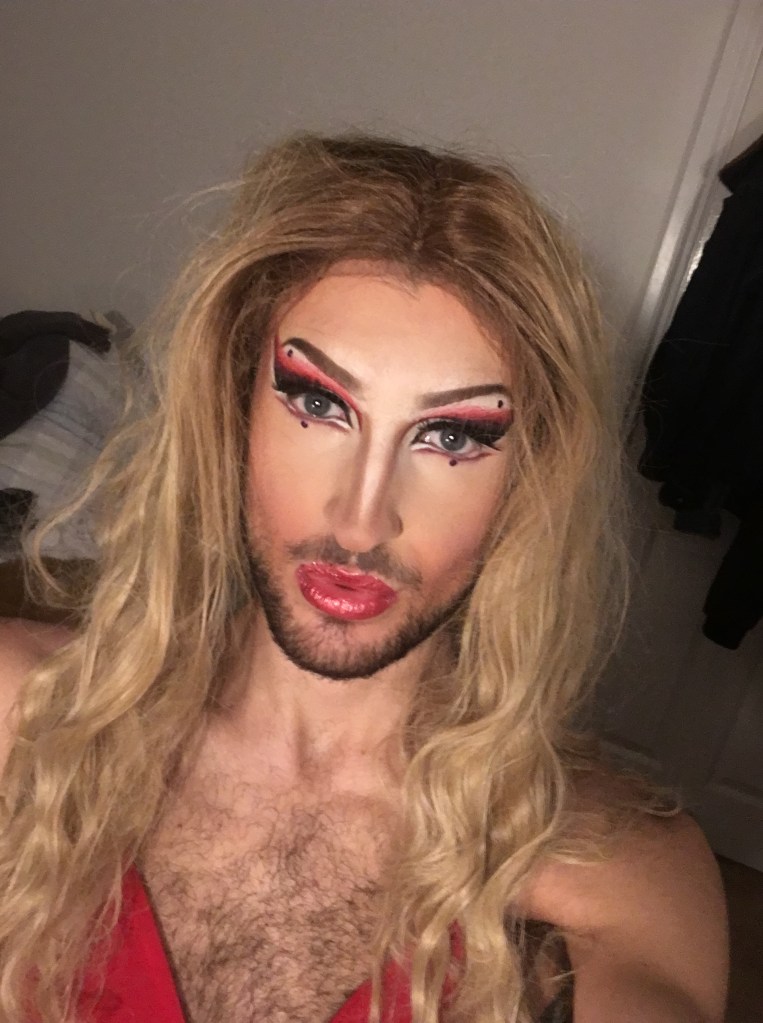
PS: I’ll post a picture of myself in drag below. For the sake of transparency. And also because I think I look pretty good.]
Here’s the picture, as promised (it’d be cruel if keyboard-WRB didn’t honour the audacity of pen-WRB):
WRB

 W. R. Bywater